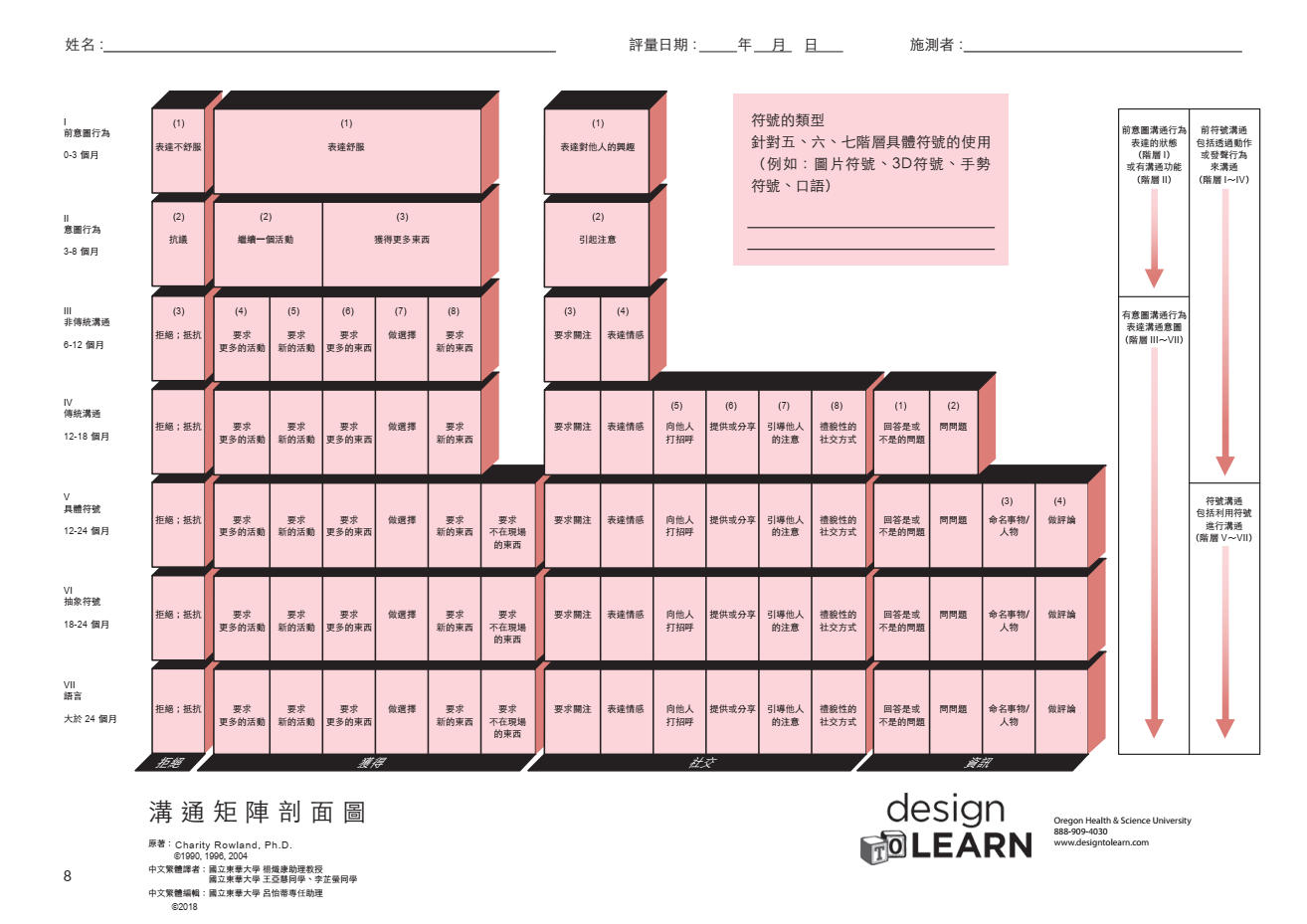
The Communication Matrix is an excellent tool for assessing beginning communicators who are non-verbal or minimally verbal. It provides a clear, at-a-glance view of an individual’s developmental abilities across different communication functions.
How to Use the Communication Matrix
First, look at the horizontal axis, which represents different communication functions:
- Refuse — expressing discomfort, protesting, or rejecting
- Obtain — expressing comfort, requesting objects or actions
- Social — getting attention, seeking interaction, expressing emotions, greeting, using polite expressions
- Information — asking questions, answering questions, making comments
Communication is not just about requesting items — there are other purposes too!
Next, the vertical axis represents the developmental levels of communication ability:
- Pre-Intentional Behavior — using movements, sounds, or facial expressions without communicative intent (e.g., crying when uncomfortable)
- Intentional Behavior — understanding that movements, sounds, or expressions lead to results (e.g., pushing blocks makes them fall)
- Unconventional Communication — using movements, sounds, or expressions to communicate with people (e.g., making sounds to get mom to come over)
- Conventional Communication — using gestures, pointing, specific sounds, or gaze shifting between a person and an object (e.g., consistently making a specific sound to indicate wanting food)
- Concrete Symbols — using pictures, real objects, or sound imitations (e.g., patting a chair to mean “sit down,” saying “moo” to mean “cow”)
- Abstract Symbols — using speech, sign language, written words, or abstract symbols (e.g., signing “help,” pointing to the symbol for “help” on an AAC board)
- Language — combining two or more words/symbols (e.g., “mom + hug,” “want + juice”)
By looking at both axes together, you can see the child’s developmental abilities across different communication functions, which informs your therapy plan. For example, if a child screams and cries when refusing something (unconventional communication), we can teach them a more acceptable form — such as waving their hand (conventional communication), pointing to a photo of head-shaking (concrete symbols), or pointing to the “no” symbol on an AAC board (abstract symbols).
Many children with autism may reach abstract symbol or even language-level abilities for refusing, obtaining, and information functions, but remain at the pre-intentional behavior level for social functions. The Communication Matrix helps us see that we need to strengthen the child’s social communication skills and helps parents understand their child’s current abilities.
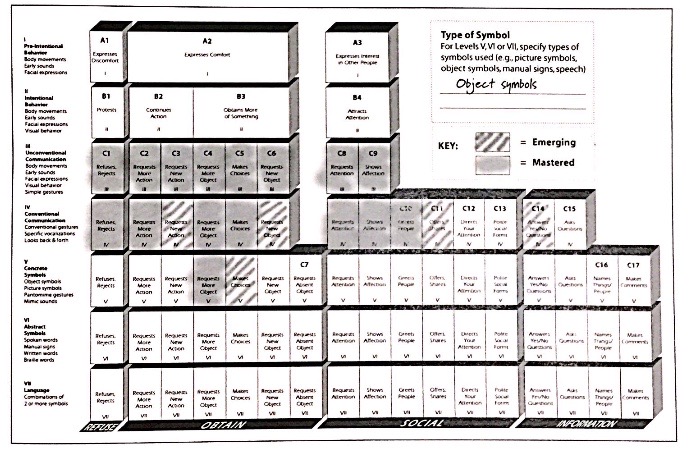
When using the matrix, you can further distinguish between emerging and mastered abilities:
- Emerging — the ability is developing but not yet consistent (mark with diagonal lines)
- Mastered — the ability is consistent and reliable (fill in the cell completely)
Example:



Comments