A young client learned to communicate with AAC incredibly fast, and I want to share this experience! I want people to know that AAC doesn’t have to start with PECS (Picture Exchange Communication System). Every child is different, and there are many different ways to communicate. Modeling AAC in context (aided language input) is essential!
This adorable little girl loves playing tickle games — running around tickling everyone and giggling! Due to brain inflammation (encephalitis), she went from being very verbal to having only some vocalizations remaining. She can follow simple instructions with gestural cues (e.g., “open the book”), and currently expresses herself through pointing + vocalizations. When upset, she lies on the floor.
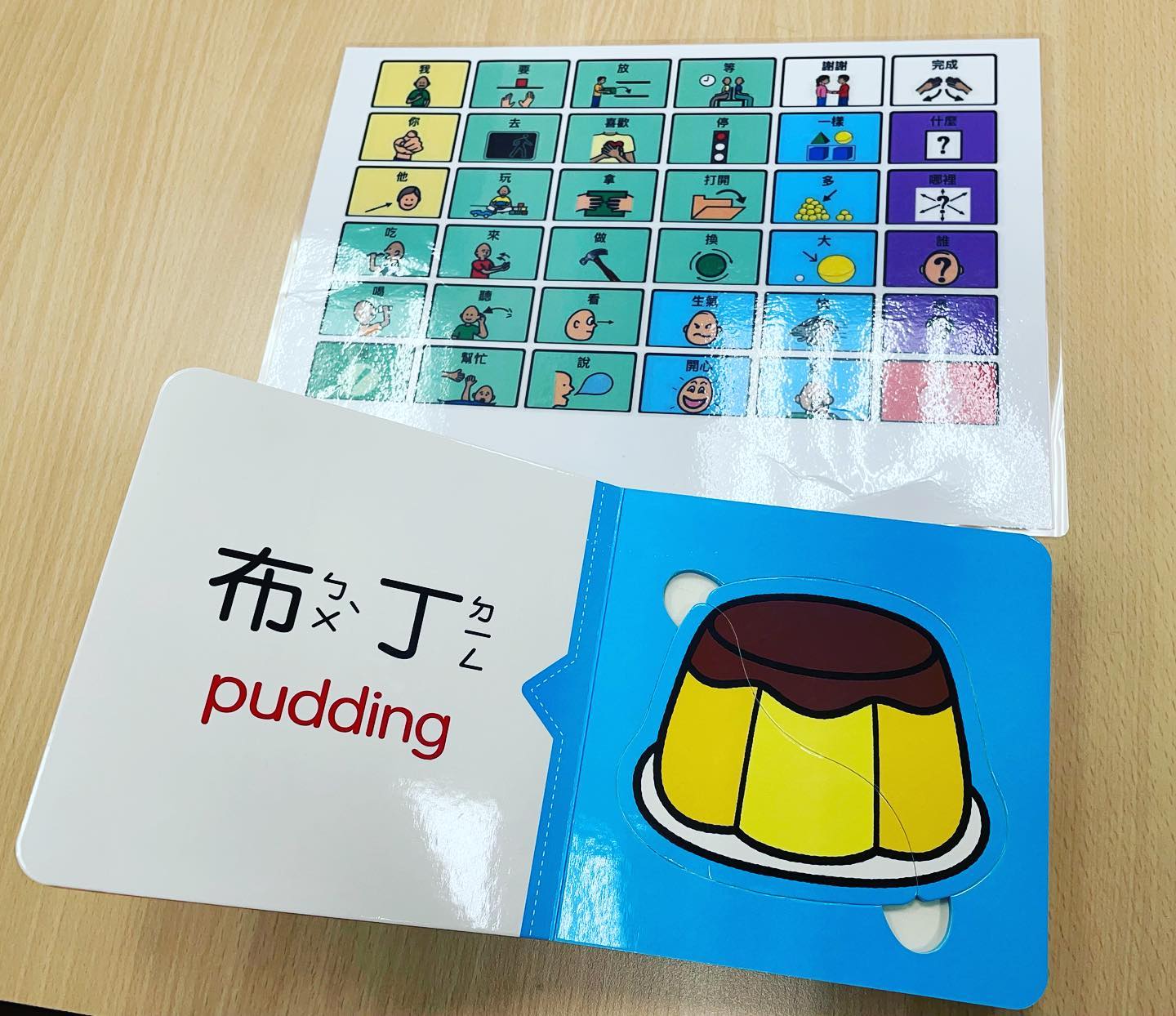
Yesterday was her first time trying a laminated paper-based AAC board (36-cell core vocabulary board). We looked at a puzzle book together.
Core vocabulary consists of frequently used words that can be used anytime, anywhere, with anyone.
Puzzle Book Activity Steps
1. Pick up a puzzle piece and give it to someone
I modeled saying “take” while pointing to the symbol for “take” on the communication board, then picked up a puzzle piece. I asked the girl to pick up a puzzle piece and give it to the student clinician.
She quickly learned to point to “take” and then pick up the piece. Later, without my modeling, she independently pointed to the “take” symbol before picking up puzzle pieces. We also named the dessert pictures on the pieces, and she imitated some sounds!
2. Get the puzzle piece back
Then I asked her to get the puzzle piece back, and after receiving it, to say thank you to the student clinician. She expressed this with a nod. We gave her lots of encouragement, and later she started nodding and bowing before picking up the puzzle piece on her own.
3. Put the puzzle piece back
Next, the returned puzzle piece needed to be put back. I modeled pointing to the “put” symbol, then placed it back. She followed along and pointed to “put” too.
4. Need help when it doesn’t fit
Some puzzle pieces were tricky and didn’t fit. I pointed to the “help” symbol and asked if she needed help. She pointed to “help” as well, and I immediately helped her place the piece in the right spot.
5. All done — yay!
When all pieces were placed, I pointed to “done” and cheered! Then she high-fived everyone!
Core vocabulary used today: take, put, help, thank you, done
Reflections
1. Encourage all forms of communication
Speaking isn’t the only form of communication. We encourage and respond to vocalizations, pointing to symbols, and gestures (e.g., nodding to say thank you).
2. Model AAC in context
Speak while pointing to vocabulary on the board. Don’t require the child to point along — they will start learning to communicate through observation.
3. Core vocabulary works in any activity
If I had only used a single picture card labeled “puzzle book” to let her request the puzzle book, think of how many language-learning opportunities would have been lost!
Comments