What Is Core Vocabulary?
Research shows that 80% of what we say is composed of just 200–300 words (Balandin & Iacono, 1999; Chen et al., 2013; Liu & Sloane, 2006). We call these words core vocabulary. Core vocabulary is a small, limited set of words that can be used regardless of time, place, or communication partner to express a wide range of communicative purposes (Banajee et al., 2003; Marvin et al., 1994). Examples of core words include: “I,” “no,” “good,” “that,” “eat.” They are mostly pronouns, demonstratives, verbs, and adjectives.
The remaining 20% consists of all other words (unlimited in number), called fringe vocabulary. Examples of fringe words include: “giraffe,” “elephant.” These are mostly nouns with specific, limited functions that often need additional language to clarify meaning. For example, when a child says “elephant!” they might mean “Look! There’s an elephant!” or “I want the elephant stuffed animal!”
Why Use Core Vocabulary in AAC?
For children who use AAC, the vocabulary in their system is the vocabulary they can express. We must carefully select the words to include on an AAC communication board.
Using core vocabulary allows…
1. Multiple Communication Functions
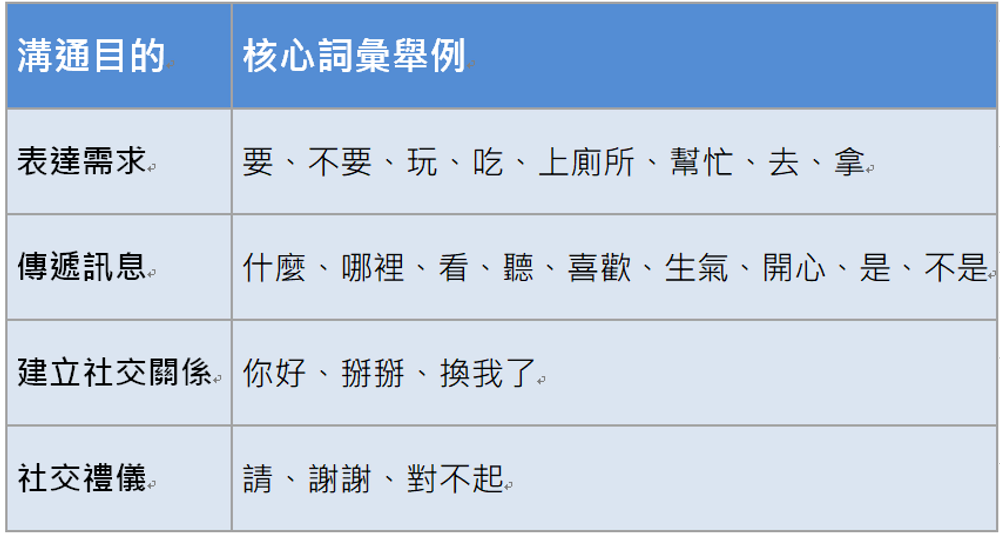
2. Communication Anytime, Anywhere
Using core vocabulary allows AAC users to communicate in any location (e.g., home, school, supermarket), at any time (e.g., mealtime, bath time, class), and with anyone (e.g., family, teachers, classmates, strangers)!
3. Personal Expression
Everyone expresses the same thing differently. For example, when someone doesn’t like a food, one person might say “No thank you, I don’t like it!” while another might say “Ugh, I hate eating this!” Using core vocabulary gives AAC users the freedom to express themselves in their own way.
4. Building Sentences
Children’s language development progresses from the single-word stage (e.g., “want”) to word combinations (e.g., “want play”) to full sentences (e.g., “I want play”). Using core vocabulary, children can start communicating with single words and then learn to combine them to express more complex ideas.
References
- Balandin, S. & Iacono, T. (1999) Crews, wusses, and whoppas: Core and fringe vocabularies of Australian meal-break conversations in the workplace. AAC: Augmentative and Alternative Communication, 15(2), 95–109.
- Banajee M, Dicarlo C, & Stricklin SB. (2003). Core vocabulary determination for toddlers. AAC: Augmentative & Alternative Communication, 19(2), 67–73.
- Chen, M., Chen, Y., & Chen, C. (2013). Do they need specific language training content?: results of core vocabulary investigation from children with/without intellectual disabilities in Taiwan. Proceedings of the 7th International Convention on Rehabilitation Engineering and Assistive Technology, Article No.: 67, 1–4.
- Liu, C., & Sloane, Z. (2006). Developing a Core Vocabulary for a Mandarin Chinese AAC System Using Word Frequency Data. International Journal of Computer Processing of Oriental Languages, 19(4), 285–300.
- Marvin, C. A., Beukelman, D. R., & Bilyeu, D. (1994). Vocabulary-use patterns in preschool children: Effects of context and time sampling. AAC: Augmentative and Alternative Communication, 10(4), 224–236.

Comments